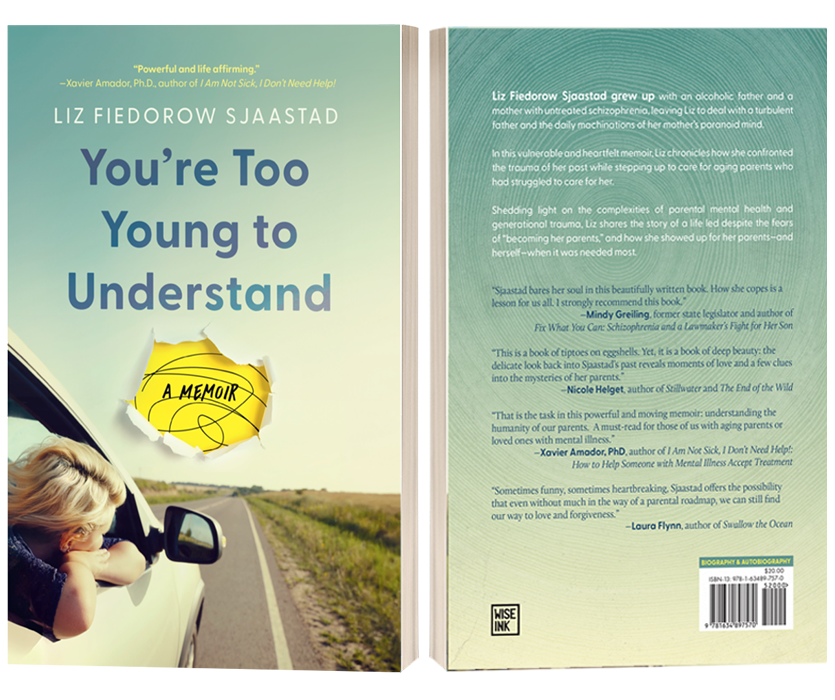
This is the front and back cover of my recently and independently published memoir.
The first twenty seconds of the podcast above is a segment from later in the podcast, and it’s me speaking. No need to listen to more.
Excerpt from You’re Too Young to Understand
MY OLDER SISTER KATE and I huddled outside the hospital meeting room. Our brother, Greg, had yet to arrive. Mom had already taken a seat inside the room by a picture window framing the Olympic Mountains. A pale mist veiled the dark forest.
In front of the mountain range, Mom ran through a repertoire of facial expressions like an actor preparing for an audition.
Kate’s shoulders turned in, and she rubbed her hands. The pained look on her face told me her strength was waning.
“How should we do this?” I lifted my chin and eyebrows.
Kate took a deep breath. “We have to be sure Mom understands what Dad’s life will be like, what her life will be like.” She squatted and dropped her head between her knees, her hair hanging down. “How is this decision still hers?” she said from behind her hair curtain.
It’d been two weeks since Dad’s massive brain bleed, and we were all on edge. Mom, on the verge of a breakdown, had been telling the nurses to put vitamin C and honey through Dad’s IV if they wanted to save him, and we were still trying to reason with her, to reach a rational person we hoped still existed despite her illness.
I reached into my purse. “Here, take this.” I extended my hand so Kate could see what I was offering. It was a Xanax a colleague had given me when I left town. Kate knew I had it, and though we were on either side of fifty, neither of us had ever taken one. The idea felt radical. She stood up, hesitated. Drugs and alcohol had ruined many in our family, yet Kate and I had escaped the darkness of addiction. She had escaped because of fear and thoughtful decision-making, and I had because . . . I don’t know. Dumb luck, maybe?
“I’ll take half.” I broke the tiny white oval in two and put one of the halves on my tongue.
Kate’s eyes lit up, and she put the pill in her mouth. We each swallowed our halves down without water and then side-smiled at each other. Mischievousness, a respite from crisis.
The doctor rushed past us and took a seat in the meeting room next to Mom. She had shoulder-length, black, wavy hair pulled back with a clip, and her full lips never moved to a smile. And why should they? What a terrible part of her job: talking with families as they decide when to let a loved one die.
Kate was stiff, her shoulders tight against her ears, making her neck look small. Sweat poured from my armpits, and I resisted the urge to let my mind wander to the mountain range. My pulse rose with the desire to release Kate from the burden of trying to enforce Dad’s wishes, but neither of us really had any control. Mom was silent, her lips pursed, eyebrows narrowed. She moved around in her chair, trying to get comfortable as her brain likely told her what she’d already told us: that we should trust no one, that the doctors might be part of a grand plan to kill her husband.
Kate and I sat at the edges of our chairs, breathing intentionally, hoping for lucid Mom but fearing the alternative.